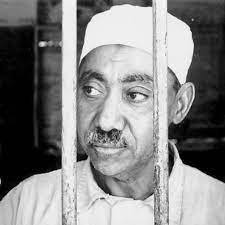
Sayyid Qutb was one of the most significant clerics, authors, poets, and political ideologists of the Egyptian Muslim Brotherhood (MB), who still has a lasting influence on the people in the Muslim world. He is known as a political ideologist of the MB among other things. He vigorously rejects cultural Westernization, secularism, all forms of jahiliyya[1] systems, and materialistic and human-made ideologies, especially in his later writings. Since his birth, in 1906, he was aware of the political and religious issues around him, because his family has also engaged in politics. One of the most important things those shaped Qutb’s political ideology were British colonialism in Egypt, his education in Colorado, his strong ties with the Egyptian MB, the Egyptian nationalist struggle, and his prison years. The term jahiliyya, ignorance of the sovereignty of Allah on earth in the pre-Islamic era, holds a central position in Sayyid Qutb’s writings. He certainly holds the opinion that the materialistic systems are the primitive and modern form of ancient jahiliyya in the Arabian Peninsula. Furthermore, this modern form of jahiliyya is not better than the former one (Shepard, 2006, p.39). His ultimate aim is to regulate the political system in accordance with the Islamic principles, in particular, to provide concrete proof those show Islam is the best antidote for this jahiliyya system, in general. Having served this purpose, he represents a clear antithesis between Islam and all other materialistic, human-made ideologies. Then he focuses on the prescriptions for the illnesses of the Egyptian society those are the results of the disastrous effect of the materialistic ideologies. He clearly aims to demonstrate that Islam is the most applicable system for all times, places, races, and nations. The roots of his ideology that Islam is the most applicable system compared to human-made ideologies can be found in his most well-known books, the Social Justice in Islam and the Milestones.
Islam is a social, economic, and political system in Sayyid Qutb’s political thought. For Qutb, although materialistic ideologies consider religion as an obstacle in the path of wealth, there is no need to show hostility to religion, yet Islam has to be recognized as a leading figure in the political arena (Enayat, 2005, p.150-2). The line between political and religious is permeable in Qutbian terminology. There is no doubt that the issues around Qutb have brought significant changes in Qutb’s political thought. In retrospect, in the 1930s, Qutb was more secularist rather than Islamist, in the 1940s, he can be considered a moderate radical Islamist, and in the 1950s, radical Islamism became more visible in his political thought (Watson, 2005, p.25-49). The main purpose of this study is to explore the relationship between Islam and jahiliyya systems in Sayyid Qutb’s political thought, in general, to analyze how Sayyid Qutb perceives Islam as a perfect antidote to all human beings, in particular. In the first part, the meaning of Islam will be given, and in the second part, the term jahiliyya will be analyzed in accordance with Qutbian philosophy, then in the following parts, the concepts of sovereignty, action, and Islamic revival will be addressed.
 Akif Avcı